I build decision systems for complex domains.
I represent the variables, constraints, and uncertainty that shape an outcome; separate what can be controlled from what cannot; simulate possible actions; and decide on the best feasible next step. Each result improves the next decision.
Decision systems · Interactive AI · Scientific machine learning
Represent → Simulate → Decide → Learn
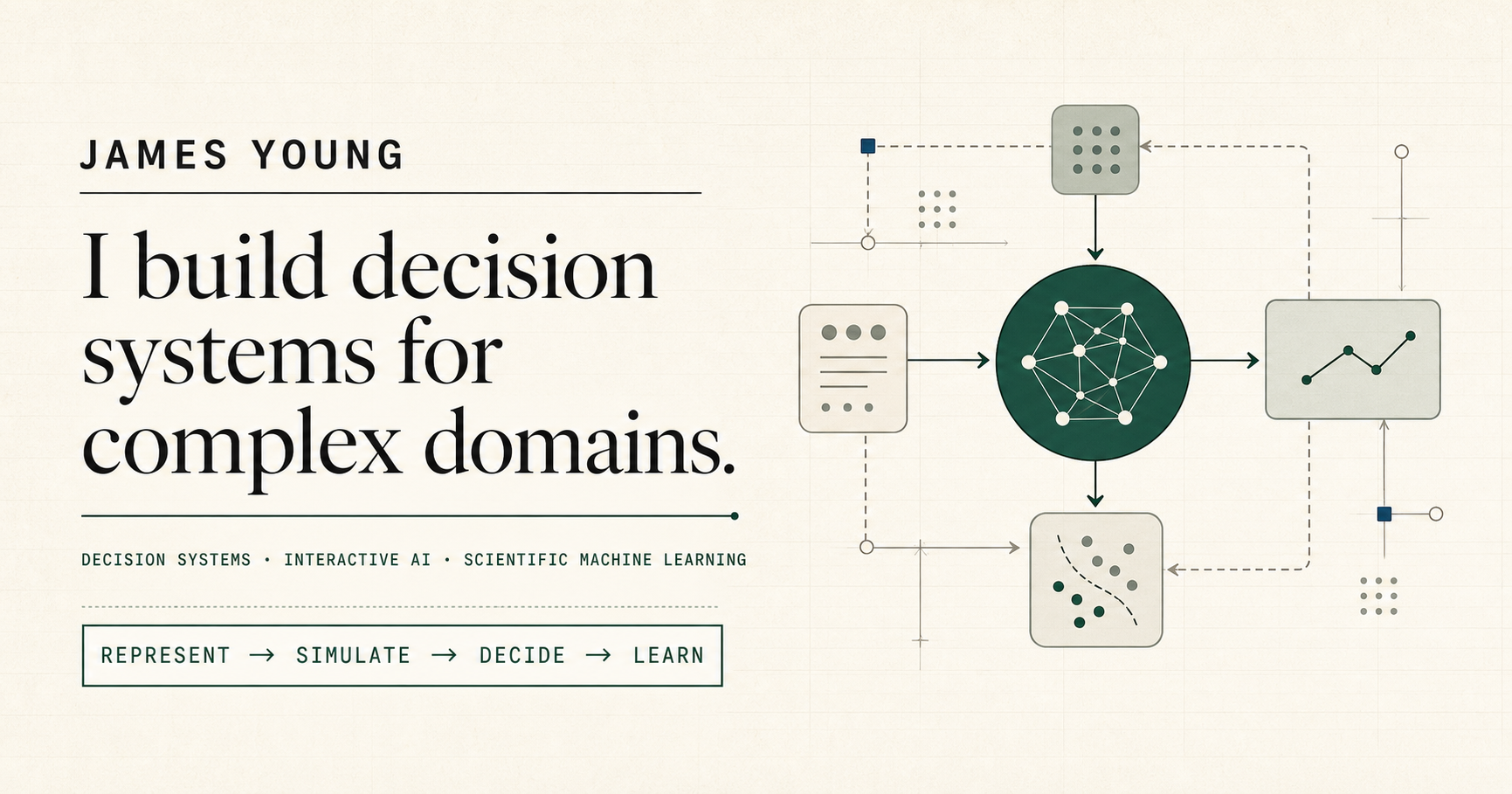
Represent the system → Simulate possibilities → Decide what to do → Learn from the result.
Represent the outcome, controllable variables, outside conditions, and real constraints. Then simulate plausible scenarios, decide among feasible actions, and use each result to improve the next choice.
The method is consistent; each implementation is built around the data, constraints, and authority of the people making the decision.
Decision systems. Interactive AI. Scientific machine learning.
Three expressions of the same approach: represent a complex domain clearly, make its possibilities explorable, and turn uncertainty into a better next decision.
Choose the best feasible action, not just the most likely outcome.
Represent what shapes an outcome, simulate realistic options, and decide what to do under real constraints. The technical foundation can include response modeling, causal inference, forecasting, and constrained optimization.
Make AI useful without giving up privacy, control, or trust.
Use local LLMs, governed conversational analytics, and adaptable pipelines to make complex work easier while keeping calculations, evidence, and sensitive data under control.
Use limited experiments where they can teach the most.
Combine biological evidence to rank candidates, balance performance with uncertainty, and choose what to test next. The methods include protein language models, multi-omics, comparative genomics, and active learning.
I work with startups, enterprises, and research institutes, beginning with one important problem and extending what proves useful.
Systems built around real choices.
Examples include optimizing resource allocation, working privately with long documents, answering business questions with evidence, adapting analytics to new data, and deciding which experiment to run next.
Optimizing resources under real-world constraints
How should limited resources be allocated when outcomes depend on many interacting factors and the final plan must obey real constraints?
View workConversational analytics with answers you can verify
How can people ask questions in everyday language and still trust where every number and conclusion came from?
View workPrivate AI for sensitive, long documents
How can people analyze sensitive, very long documents without sending the material to a cloud service?
View workAnalytics that adapt to each organization’s data
How can a proven analytical and optimization method work across teams, brands, regions, and data structures without being rebuilt by hand each time?
View workChoosing which genes to test for oxygen-tolerant nitrogen fixation
Which undercharacterized genes should researchers test next to understand how some cyanobacteria fix nitrogen in the presence of oxygen?
View workChoosing which protein variants to test next
How can researchers choose a small, informative set of Rubisco variants from a protein sequence space too large to test exhaustively?
View workPublished research shows the method in a difficult setting.
When every experiment is slow and expensive, choosing what to test next matters.
I combine biological evidence and machine learning to narrow large search spaces, compare promising candidates, show what remains uncertain, and plan the next useful experiment.
Predicting FOX gene candidates for oxic nitrogen fixation using multi-omic machine learning and comparative bioinformatics
Open paper
Active Learning on Protein Language Model Embeddings Accelerates Rubisco Variant Discovery for Desired Traits
Open paper
Secondary Metabolites Predict Diazotrophic Cyanobacteria: A Model-Based Cheminformatic Approach
Open paper